My beloved Lucy, companion for 13 years, my service dog for 7, passed quietly in her sleep last night. I am profoundly grateful for the love and support of my family and friends at this difficult time. I also thank the staff at John Young Animal Hospital who have been my partners in her care for the past 10 years.
For those of you who would like to know more about my relationship with Lucy, please read on. This is long, and there are things below which I have never shared with anyone under any circumstances. I hope that in sharing these thoughts I can honor her in some way.
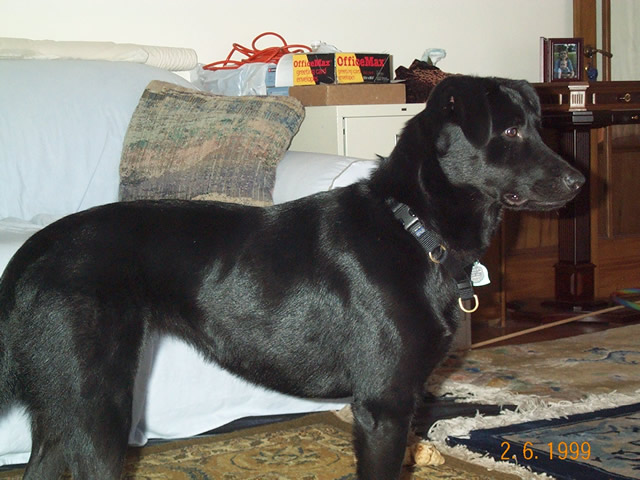
Sleek and shiny. What a beauty
In 2002 the circumstances of my life had changed dramatically. I had become severely disables and was no longer able to drive, cook for myself, or handle many of the daily functions of life without considerable assistance. That assistance was mostly in the form of Victor Antoine Roldan. Few people have ever understood the nature of our relationship. How could they. He was really the only person who I allowed to see the full extent of my infirmity. Pride coupled with shame is a terrible thing and generally serves to drive those who care out of our lives. It certainly did in my case.
I was spending most of my time at home and had said to a friend that maybe I would finally be able to have a dog. It could make a good companion for me.
Antoine took me to a house warming party for a friend of a friend. I was sitting on the floor in the kitchen (actually too weak to stand up on my own, not that anyone there but Antoine knew that) when in walked a young woman named Erin with a mangy looking, nothing but skin and bone, black lab mix. She had rescued the dog from a bad situation and was trying to find a home for her.
She asked me if I would be willing to hold onto her leash while she visited with her friends. Of course I would.
She laid down on the floor near me. I had some chicken wings. I tore off some of the meat and offered it to her. Yummy. And before long she was eating as much as I could give her.
About that time Erin came walking around the corner and looked at me in horror. WHAT ARE YOU DOING?
I tried to apologize. She looked hungry and I’m sorry if… You don’t understand. Lucy had been refusing food for several days and nothing Erin had tried had gotten her to eat. It was like a miracle.
It’s amazing how the world sometimes listens and gets it just right. A few days later, Erin brought Lucy to live with me and our odyssey began.
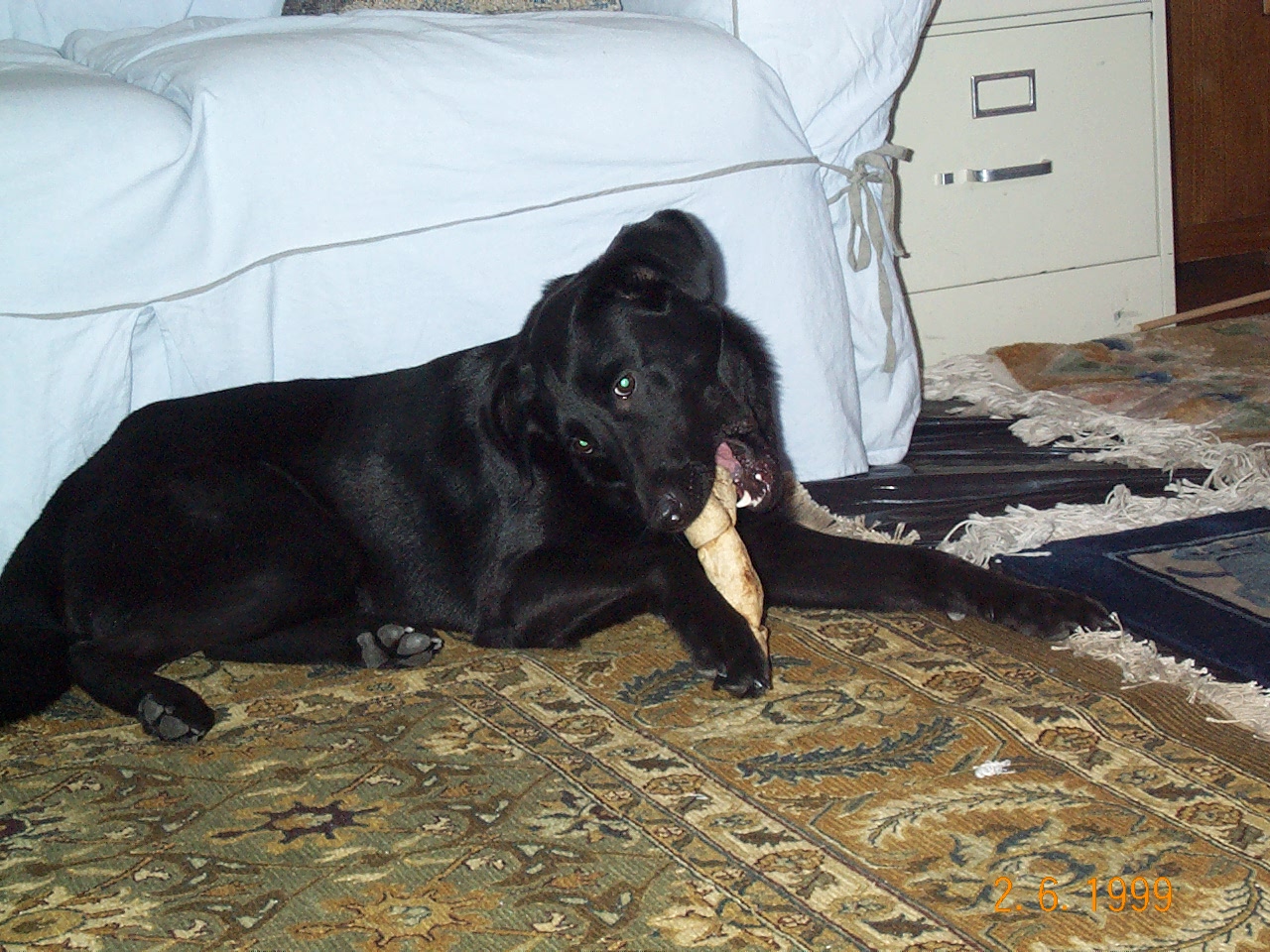
Lucy with her chew bone
Lucy needed a lot of care. Little by little Antoine and I were able to nurse her back to health. She had some serious behavioral issues too. When she was physically better, I did some asking around and found a woman who specialized in helping to rehabilitate seriously abused dogs. I made an appointment for her to come to the house and evaluate our situation.
What Alison told me was not promising. She had been doing work with severely abused animals for over 15 years. In her opinion, Lucy was the most damaged dog she had ever seen and did not really think she would ever be able to live any kind of normal life. Lucy was fearful, unpredictable, and while seemingly passive exhibited signs of extreme aggressiveness that would make her a danger to anyone she was around, including me. I would never be able to take her in public. Even having people to the house would be extremely risky. In all her years of doing work she had never once recommended this, but she felt that Lucy’s problems were so extreme that I should seriously consider having her put down.
If I didn’t want to do that, she was willing to try but really felt there was not much hope.
I said, “Let’s at least try.” Alison was a proponent of Clickers and Positive Reinforcement. She was very afraid that if I did anything aggressive towards Lucy she could snap and seriously injure me. She showed me things I could do and gave me detailed instructions. We made a follow up appointment for the next week.

Looking happy
When Alison came back a week later, I showed her what Lucy and I had been working on. Little things like just standing quietly by my side (and NOT quivering in fear.) Alison was pleased and we put together a few more exercises for Lucy and I to work on and went over everything in detail. She was going on a trip and so we made an appointment for two weeks later.
Two weeks later, Alison came by again. Again, we showed her what we had been up to. Alison was a bit mystified. She asked me a series of very detailed questions about exactly what I had been doing.
I was doing what I had been told to do. By which I mean, I was doing EXCACTLY what Alison had told me to do in EXACTLY the way she had told me to do it. What she didn’t understand was that 1) I’m a Round Dancer, and if you tell a Round Dancer to stand on one foot, spin three times while whistling a silly tune, they will ask which foot, find out what direction and kind of spin you want, and learn the specific silly tune you want, then DO IT just the way you told them told to the best of their abilities. And 2) I didn’t really have anything else to do.
It took about six months of work. Describing even with brevity what Lucy (and Antoine) and I went through during that time would take a few pages, and as you all know, I’m not exactly a master of brevity. This is already going to be very long.
Needless to say, eventually Lucy managed to become a somewhat reasonably normal dog. With a few odd issues.
She was dog aggressive (something I was never able to fully get rid of.)
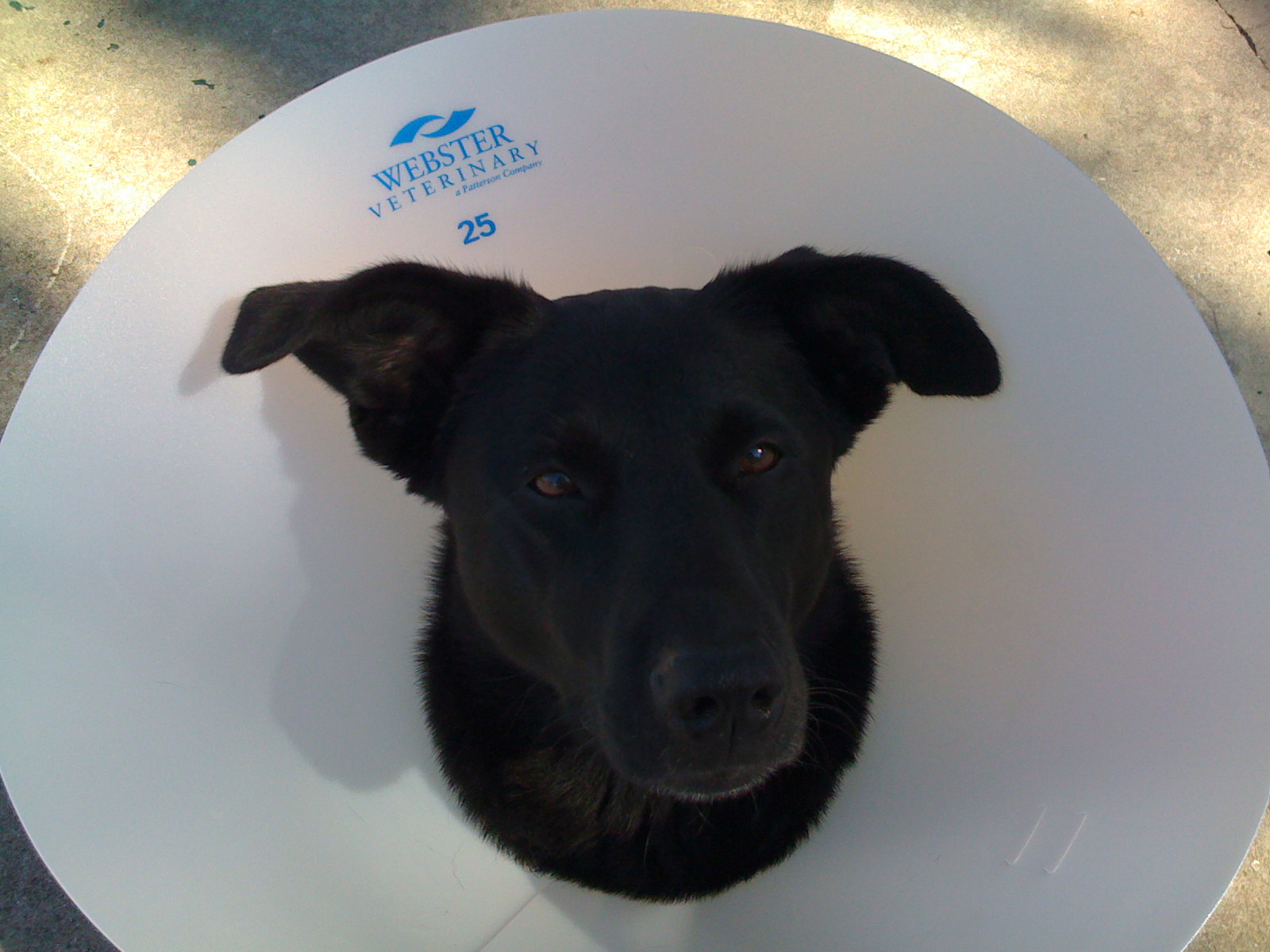
And she would on occasion refuse to let me stand up, or block me from trying to leave the house, or even sometimes knock me to the ground and lay on top of me.
I asked Alison to come and take a look. Of course, Lucy behaved wonderfully while she was there and Alison could offer me no insight into the issues I was describing.
The odd behavior continued and escalated, becoming more frequent although also intermittent. Most of the time I could leave the house without incident, but every once in a while Lucy would just knock me to the ground and refuse to let me leave for 10 or 20 minutes. Or stand behind the car in the driveway and refuse to move, snapping and growling so that neither Antoine nor I could go near her to get her out of the way, and only calm down if I went back into the house.
I called Alison again, describing the increasingly odd and aggressive behavior. She came over that evening around dinner time. Antoine was downstairs cooking (I had been forbidden to use knives or the stove after nearly cutting off my fingers several times and almost burning down the house twice. Issues related to my medical situation.)
I was describing the behavior again just as Antoine came walking up the stairs with my dinner. As he walked into the room he said, “She only does that when you are about to pass out.”
“Pass out?”, Alison inquired.
When I was 22, I had been told I would never walk again. Rheumatoid arthritis. I’m allergic to most of the medications that are used to treat arthritis. I had learned how to (mostly) mask the fact that I was in constant pain. Through diet, exercise and lots of hot water I had learned to (mostly) manage the impact of the arthritis.
Hot water was is my best friend. Most people think it’s an affectation that I have always taken long, hot showers. The truth is that those showers are how I managed my joint pain for nearly 30 years, and are still an important of my daily routine.
It could take one to three hours each morning for me to get my body able to move “normally”, even before I started having new problems. I was rarely willing to share a hotel room, because doing so made it difficult if not impossible to go through my morning rituals that helped me manage the pain that was a part of my daily existence and couldn’t be masked with medication.
I learned how to hide what was going on with my body and what it took for me to go out into the world.
The infection I had gotten had acted as a catalyst to re-ignite the arthritis and brought on a whole new set of medical issues each horrible in it’s own right. What had been a challenging set of issues related to my arthritis had become much more.
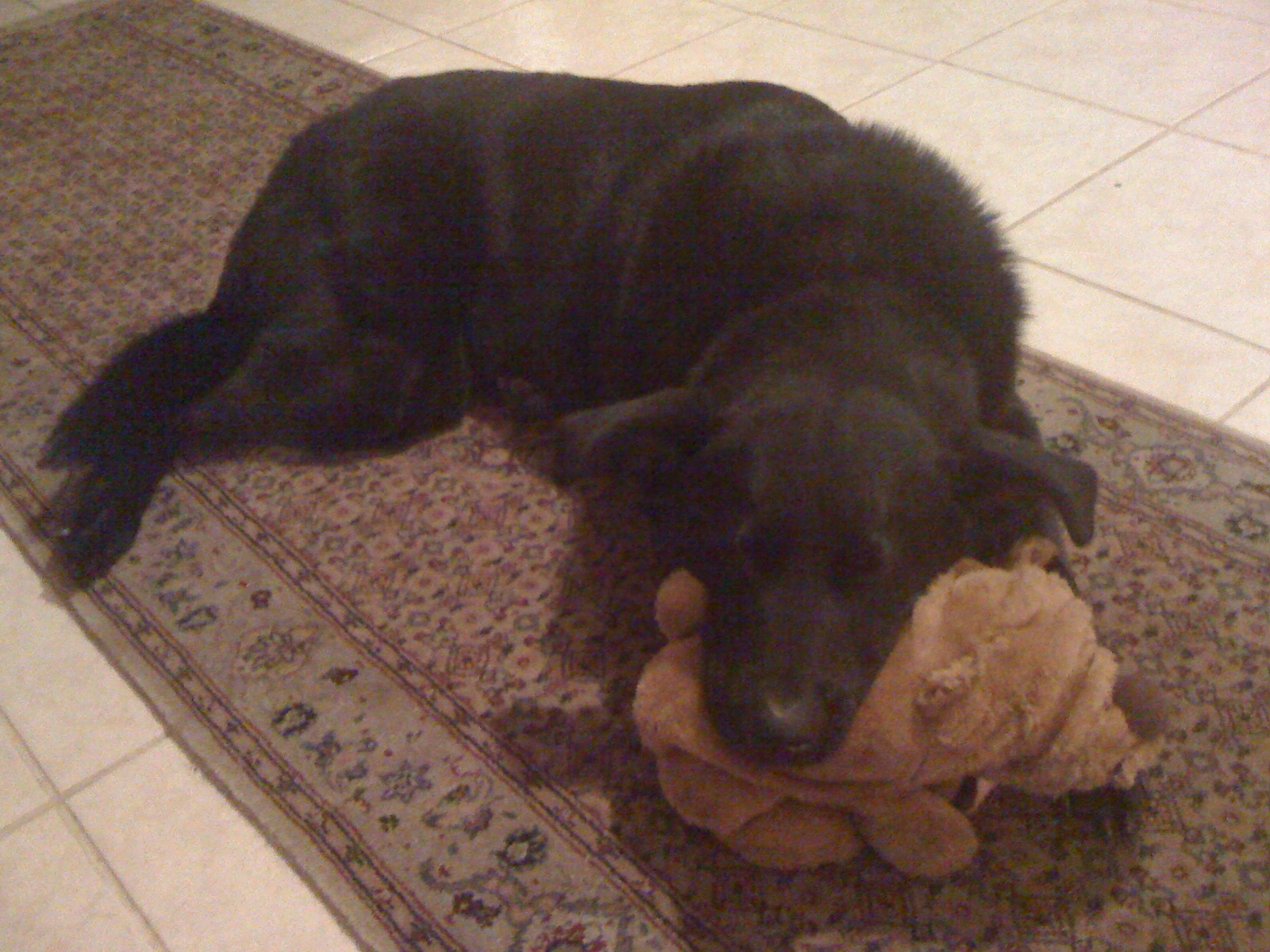
A bear given Lucy by a TSA agent during one of our trips.
Some days my hands just wouldn’t work and I couldn’t open doors, jars, use utensils, zippers, buttons, put on shoes.
What I had thought of as PAIN turned out to be mild in comparison to what was possible for the human body to experience and survive.
My energy level was basically NIL most of the time. My mental focus bounced between NONE and so focused that I was scary good at certain kinds of problems, but when in that state completely unaware of the rest of the world and my own physical needs. (Some of the work I did during that time was revolutionary.)
All in all, I was not what one would describe as well.
I was put on a medication that had serious side effects, one of which was at least once a day I would blackout and have what was essentially a seizure. No other medication was available, and without the medication, I was told that I would most likely die.
ROCK >>> ME < << HARD PLACE.
Creating the illusion that I could go out into the world and function normally consumed most of any given day just so that I could go teach an hour or two of dancing, or meet friends for dinner (but never both in the same day.) And once back home after those short forays into the real world, recovering enough to climb the stairs and get ready for bed could take another hour or two.
The flight of stairs in my house was something I could manage once a day. Getting down required I sit and slide down one step at a time. Climbing back up could only be accomplished on my hands and knees and could take several minutes. A shower was rarely less than an hour, during which I would go through an elaborate stretching ritual that would gradually get my joints moving. Getting dressed could take 30 minutes to an hour.
I never, not even once, allowed anyone to see me do this. Not even Antoine.
If Antoine couldn't come over to cook, I generally just didn't eat.
If he wasn't available to drive, getting behind the wheel of the car put myself and everyone else on the road in significant danger.
[caption id="attachment_267" align="alignleft" width="300"]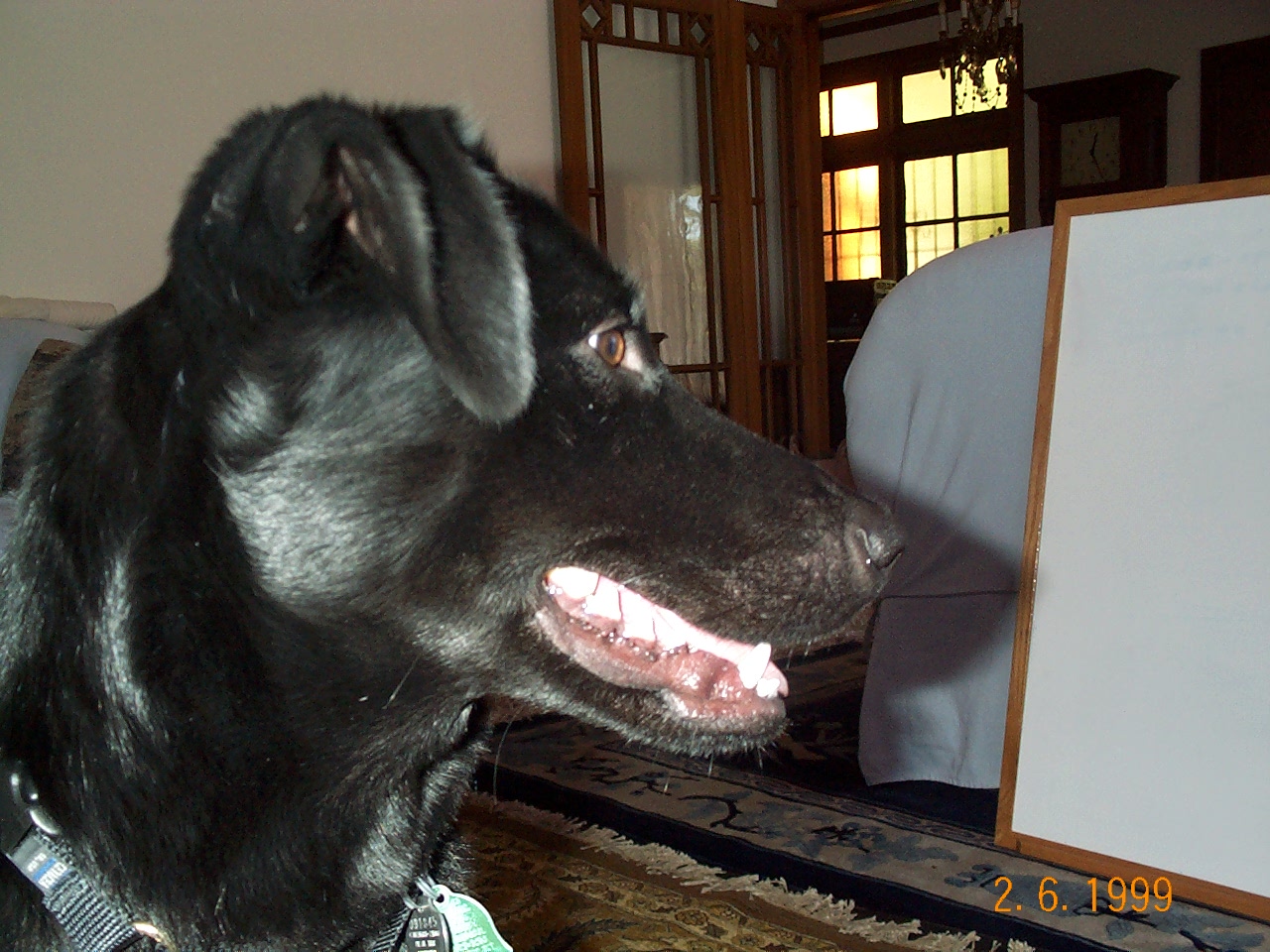 Beautiful Smile[/caption]
Pride. Shame. Vanity. Stupidity. Take your pick. I spent a lot of time and effort doing my best to hide the full extent of the true nature of my daily existence from everyone. And I mean EVERYONE.
This was news to Alison. I had never mentioned that I had any medical issues. It was not something I talked about, and in fact, very few people knew more than I had a something wrong and only Antoine had any clue as to how serious any of this was. Daily life was nearly impossible at this point.
I had almost completely stopped dancing. And what I did was so painful that afterwards I would often sit in the car and cry in agony. But never in front of anyone.
Pride. Shame. Vanity. Stupidity. Lots and lots of stupidity.
Lucy was my escape. In the safety of my own home, I could have her by my side. Unquestioning love and something I could DO that didn’t expose my infirmities. She didn’t care how long it took me to do something, or how I looked, or if I was in pain trying. She didn’t judge. She didn’t pity. She didn’t ask what or why or how come.
Together we learned patience and cooperation. Each day she would come down the stairs with me. One slow step at a time. Me never realizing that what she was doing was physically very difficult for a dog to do. All of her weight being held on her front shoulders as she used her body to press me against the wall and prevent me from falling.
Pushing her head against my tushy as I slowly climbed, holding my weight against sliding back down.
Lying on top of me so that I couldn’t thrash around while passed out.
Without my knowing it, or Antoine’s understanding the significance of it, she has quietly learned to notice that I was about to pass out. Her response was to try and warn me. If that didn’t work, then she would physically block me. Then while I was unconscious she would guard and protect me.
Not even Antoine could get near me while I was unconscious if Lucy was by me.
“Pass out?”, Alison said.
As it turns out, working to rehabilitate severally abused dog’s was Alison’s side line. Most of her work was in training service dogs to help people with various disabilities.
And so a new chapter in our lives began.
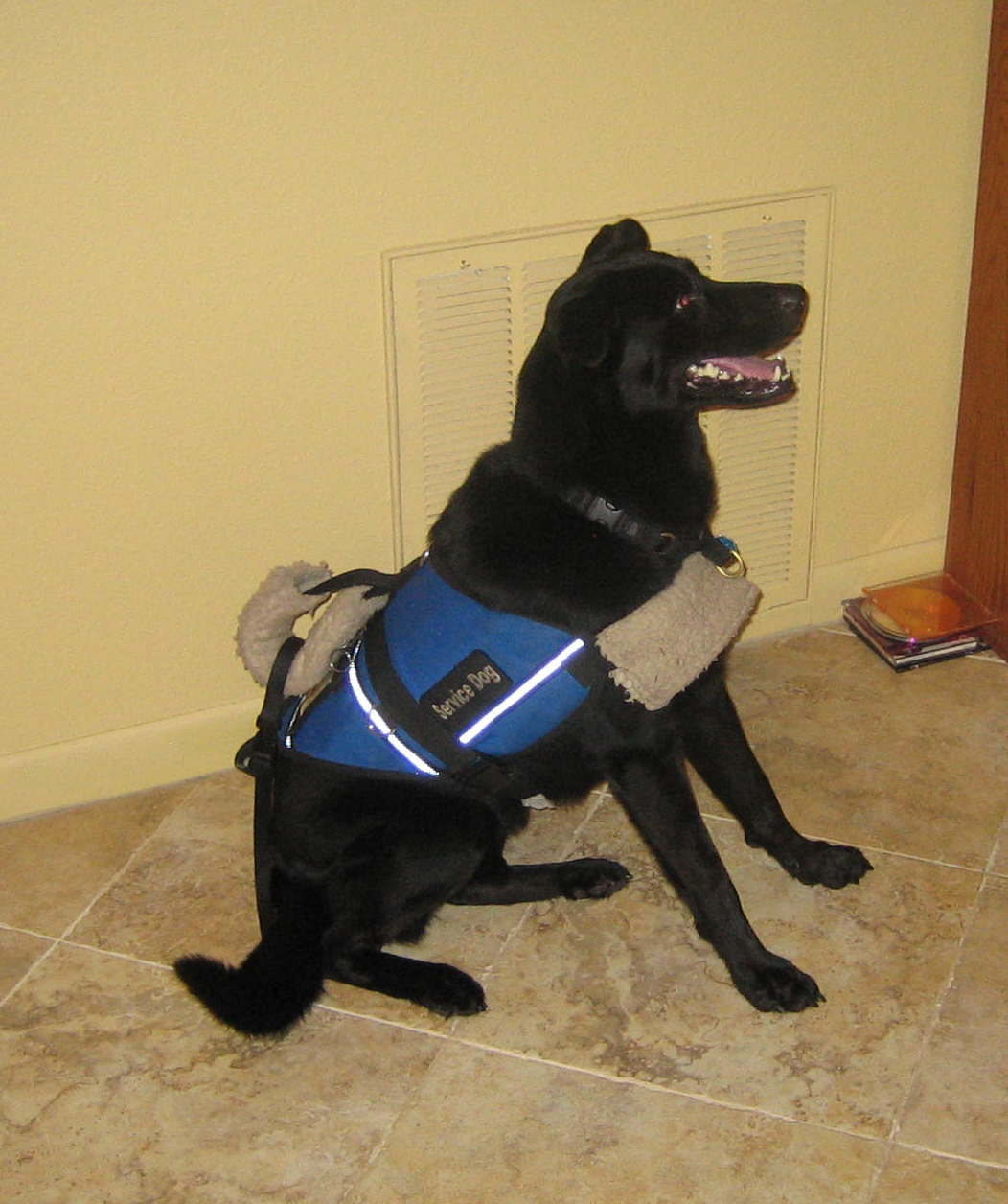
Looking smart in her blue vest
Lucy began an intensive (and fairly expensive) training program custom designed to give her the skills she would need to be my companion and allow me to return to a more normal life.
During that time, my health also improved significantly. Not enough to allow me to live a normal life, but enough that I could do more than an hour or two in public before collapsing for two days to recover.
While I still had significant medical issues, the pain was mostly managed through diet, exercise and hot water, as it had been before. My energy levels were mostly normal. My mental focus was vastly improved to the point that no one was aware that I had issues.
The medication was doing what it was supposed to do, BUT, the side effect of the blackouts was still a part of my daily existence.
Once her training was complete, Lucy became my constant companion, going everywhere with me. This often required dealing with travel by car, train, bus, and plane. She was even on a few boats.
Conventions could result in days that were 16 to 18 hours long.
Loud, uncomfortable spaces. No good place for her to lie down. No regular schedule for water or food. Often limited access to ‘outside’ to deal with basic doggy biological functions.
Lucy rarely complained. Mostly she just did what there was to do. And she always remained focused on making sure I was OK. In all the years she was actively in service at my side, she never once missed alerting me in the timely fashion that my blackout was imminent.
I have lots of stories about funny things that happened, like when I had tied her to a large round banquet table and gotten involved in dancing. Suddenly the music stopped mid song. She had waited long enough for me to come back, gotten up, and dragged the entire table into the middle of the dance floor to look for me. Sure enough, less than 15 minutes later, I was flat on my back on the floor unconscious to the world, while she lay on top of me and wouldn’t let anyone near.

At Universal with David and his cousins
Or the time we were trapped in the left lane on an Interstate highway in a traffic jam stretching miles in both directions. She had indicated that I needed to be STOPPED and NOT behind the wheel of the car quite some time before. I had not complied. Just as trained, her attempts to get my attention and compliance gradually escalated until I had a 55 pound dog sitting in my lap completely preventing me from being to operate the car. There was no explaining that we were trapped and there was nothing I could DO. Her training had been quite specific and very thorough. I was NOT doing what I was supposed to do, so she was going to make sure I couldn’t move.
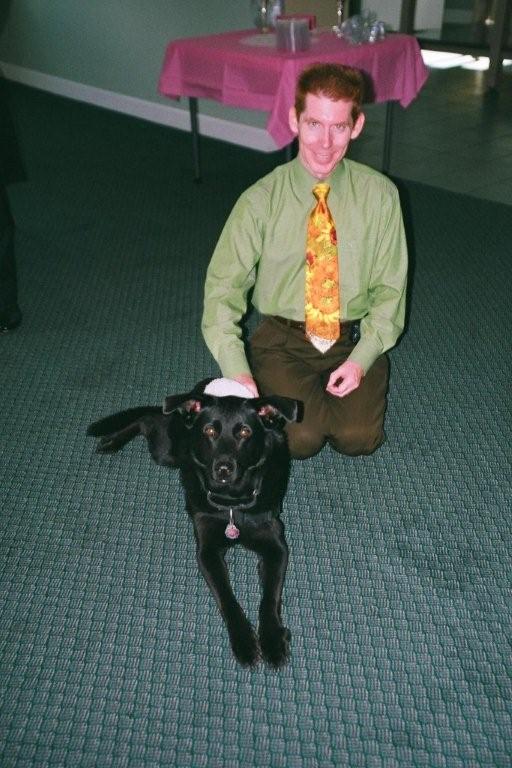
At Sandy’s wedding
I could go on. There are countless stories of how Lucy was there for me, helped me.
Back in 2009, a new medication became available. I was put into a study so that I had early access. Over the course of the next year, I was slowly able to wean off drug that had cause the horrible neurological side effects that I had been dealing with. Simultaneously, my physical issues were greatly improving again.
By mid-2010, Lucy was no longer needed as my Service Dog and she transitioned into a more normal life as ‘pet’.
My health has continued to improve and today, no one would ever look at me and think DISABLED. No one who I did not tell would ever know that I had once been 100% disables, unable to walk, drive, cook, take care of myself on my own, or that I spent nearly 10 years having daily blackouts.
People who came to our home saw a big, black, happy dog who barked, played, chased squirrels, got on furniture, and generally did all the things dogs do, including acting like she had never been taught even the most basic of commands like SIT, DOWN, or STAY.
Lucy was not my pet. Nor was she my ‘child’.
She was the being who gave me freedom and independence at the expense of her own.
There are not words to express the depth of my feelings toward her, or the important of her role in my life.
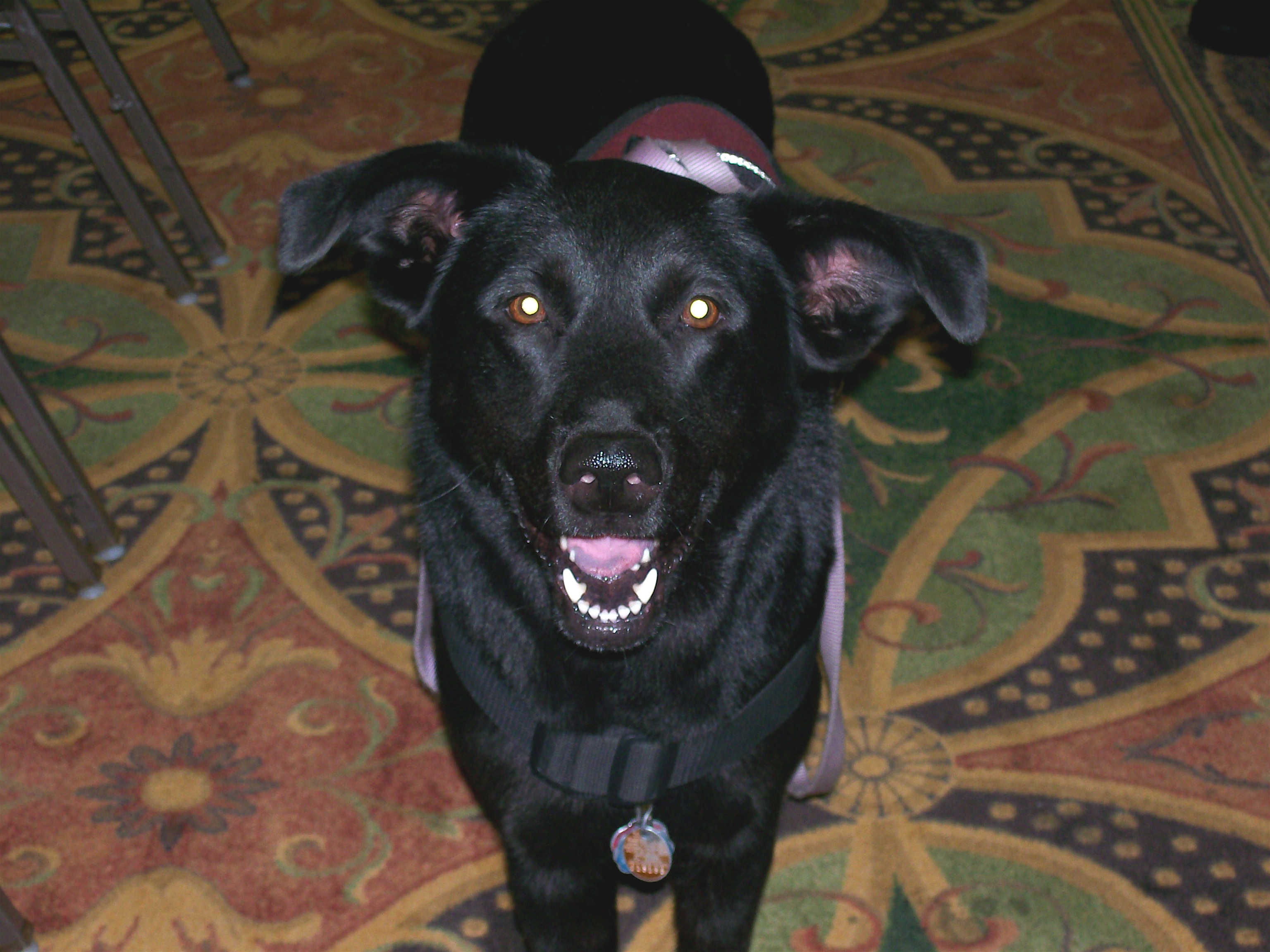
At a Landmark Seminar – one of my favorite pictures of my beloved Lucy

The last picture I took of my beloved Lucy
She was loved. Greatly loved.
She will be missed. Greatly missed.